
What business automation actually means for a small team.

Ask five suppliers what business automation is and you will get five answers, each shaped by what that supplier happens to sell. That is most of why the word is hard to pin down. It has been defined by people with something to move, not by anyone trying to explain it.
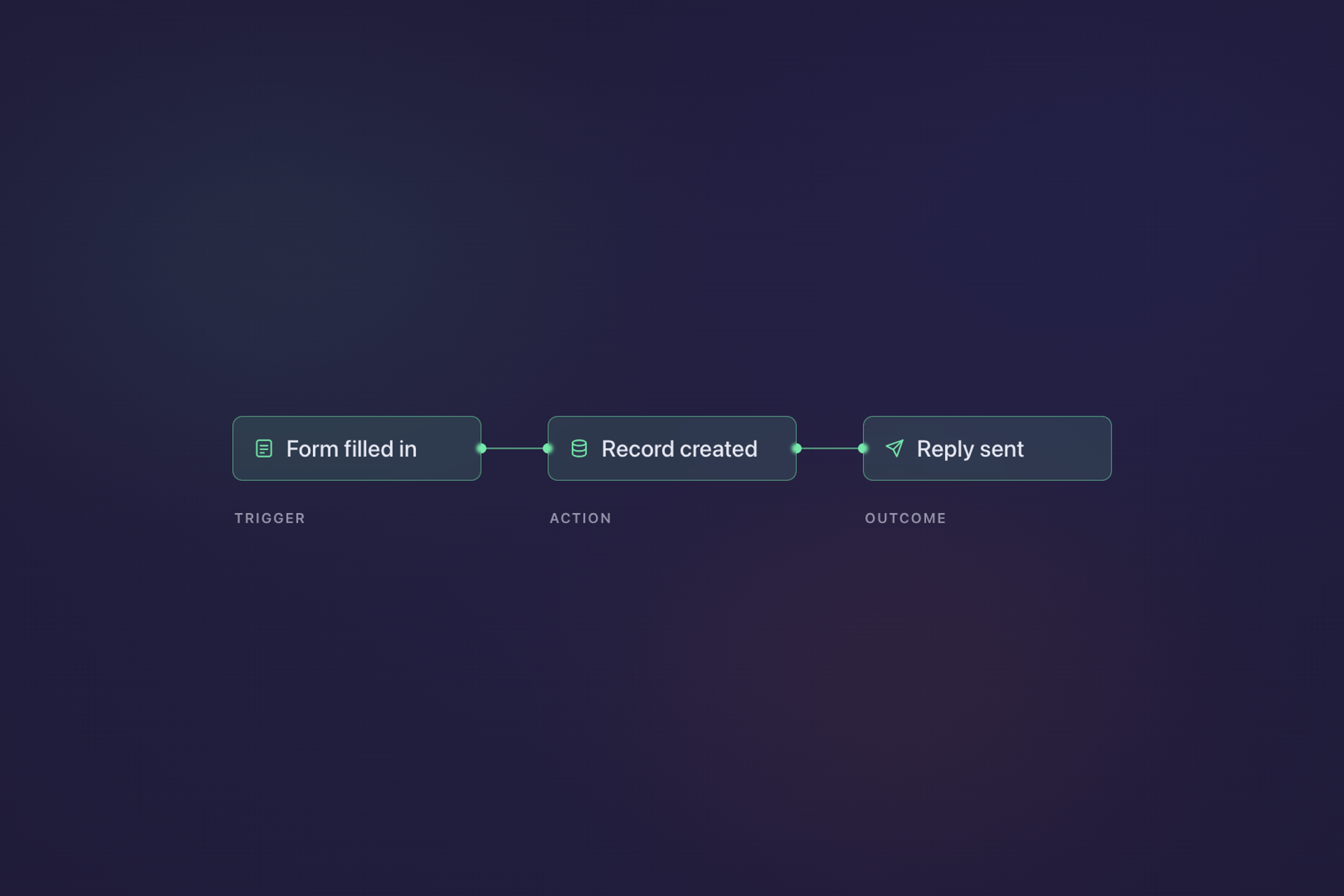
Strip the sales language out and it is simple. Automation is a step somebody currently does by hand being done by software instead, on a rule your business sets. That is the whole idea, and everything after it is detail: which step, which software, which rule.
The unit is smaller than you think
The word conjures a machine running your company while you watch. The reality in a business of ten people is a handful of small handoffs, each saving somebody twenty minutes a day. That is the size of business most of the UK actually is: of the 5.7 million private sector businesses at the start of 2025, 99.85% had fewer than 250 employees, according to the Department for Business and Trade's business population estimates (October 2025).
An enquiry arrives through the website and lands in the shared inbox, in the CRM, and in a message to whoever is on duty, without anyone copying it across. A job marked complete on the Friday puts a draft invoice in front of you on the Monday with the hours already filled in. A customer nobody has contacted in ninety days appears on a list instead of being forgotten. None of that is impressive on its own, but added together it is most of what a small business gets from automation, and it is worth more than the impressive version.
Twenty minutes a day sounds like a rounding error until you add it up. Across 230 working days it is about 77 hours a year for one person, roughly two working weeks, and a team of ten with one such handoff each gets back something closer to five months of somebody's time.
The unit matters because it sets the risk. A handoff that goes wrong costs you an afternoon. A system running your company that goes wrong costs you the quarter. Small pieces also tell you quickly whether the idea was any good, which the large version never does until it is too late to change your mind.
What it is not
It is not artificial intelligence, though the two now turn up in the same conversation. The Office for National Statistics found in June 2026 that 28% of businesses with fewer than ten employees reported using at least one AI technology, against 49% of those with 250 or more. Automation does not need to be in either figure, because most useful automation involves no judgement at all: it moves information from one place to another and applies a rule you wrote. The rule is yours, it is written down, and it does the same thing every time. That predictability is the point, not a limitation of it.
It is not a replacement for a person, because it removes tasks rather than roles. The McKinsey Global Institute's November 2025 estimate that today's technology could in theory automate activities making up about 57% of US work hours is often quoted as if it were a headcount forecast. The report, Agents, robots, and us, is careful on exactly that point:
"This estimate reflects the technical potential for change in what people do, not a forecast of job losses."
If the tasks automation removes are most of somebody's week, that is worth knowing before you start, and it is a conversation to have with them rather than around them.
If the tasks automation removes are most of somebody's week, that is worth knowing before you start, and it is a conversation to have with them rather than around them.
It is not a fix for a process that does not work. This is the expensive one. Automating a broken process gives you a broken process running faster and costing more, with the added problem that it is now harder to see, because nobody is touching it any more. If a step causes trouble because nobody agrees who owns it, software will not settle the argument.
And it is not a project with an end. Your business changes and the rules need changing with it. That is a small ongoing cost rather than a large one, but it is not nothing, and a supplier who never mentions it is either inexperienced or hoping you do not ask.
What it costs to start
The entry cost is lower than most people expect, which is part of why it is worth trying small. As of September 2026, Zapier's free plan runs 100 tasks a month and its Professional plan starts at $19.99 a month billed annually for 750 tasks, while n8n's Community Edition is free to run on your own server. A single handoff of the kind described above usually fits inside the free or entry tier.
The real cost is the time to describe the process properly and the few hours a month somebody spends keeping the rules current. Budget for that rather than for the software, and the first automation is a small decision. We cover which tool to run it on in Zapier, n8n, or bespoke.
Where this leaves you
If you are weighing up whether automation deserves your attention, the useful question is not whether the technology works. It does, and it has for years. The question is whether you have specific, repeated, rule-based work that a person is doing today and resenting.
Most small businesses have several, and they tend to be dull. Being dull is exactly why they qualify: the work nobody wants to describe in a meeting is usually the work that has been done the same way for three years without anyone asking why.
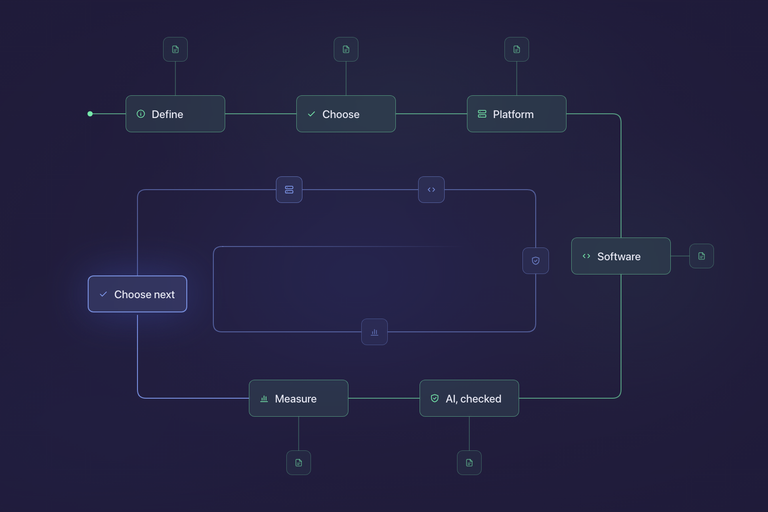
Start there, by writing down what the task is, how often it happens and how long it takes. Within an afternoon you will know whether it is worth automating at all, and that is a much smaller decision than the word makes it sound. When you are ready to pick the first one, our guide to workflow automation for small UK firms walks through the whole sequence, from choosing a task to judging whether it paid off.
It is also most of what we do. For a business this size we build a handful of small handoffs rather than one system, scoped one at a time, so each pays for itself before the next is worth buying.
Got a project in mind?
Or just want to talk through an idea? We are always happy to chat, no strings attached.