
A brand is more than a logo.

When somebody asks for a logo, what they mean almost always is that the business has grown past the version of itself it built at the start, and nothing looks like it belongs together any more. The website says one thing, the van says another, and the quote document says a third. The logo is the piece they can name.
What gets commissioned, and what was needed
A logo is a mark that identifies you, and a good one does that in a small space, in one colour, at a distance, for a long time. That is a real job and worth paying for.
What it cannot do is decide anything else. It will not tell a designer what your emails should look like next year, or settle whether your photography is warm or clinical, or determine how you sound when a customer complains. A mark on its own answers none of that, so all of it gets decided again, separately, by whoever happens to be doing that piece of work that week.
The result is familiar: a business with a decent logo and no coherence anywhere else. Six shades of the same blue across four documents, three typefaces because three people made things, and a tone shifting from stiff to matey depending on who wrote it. None of it is a disaster, but all of it costs you quietly. A company that looks assembled from parts reads as smaller and less careful than it is, and that reading happens before anyone has judged your actual work.
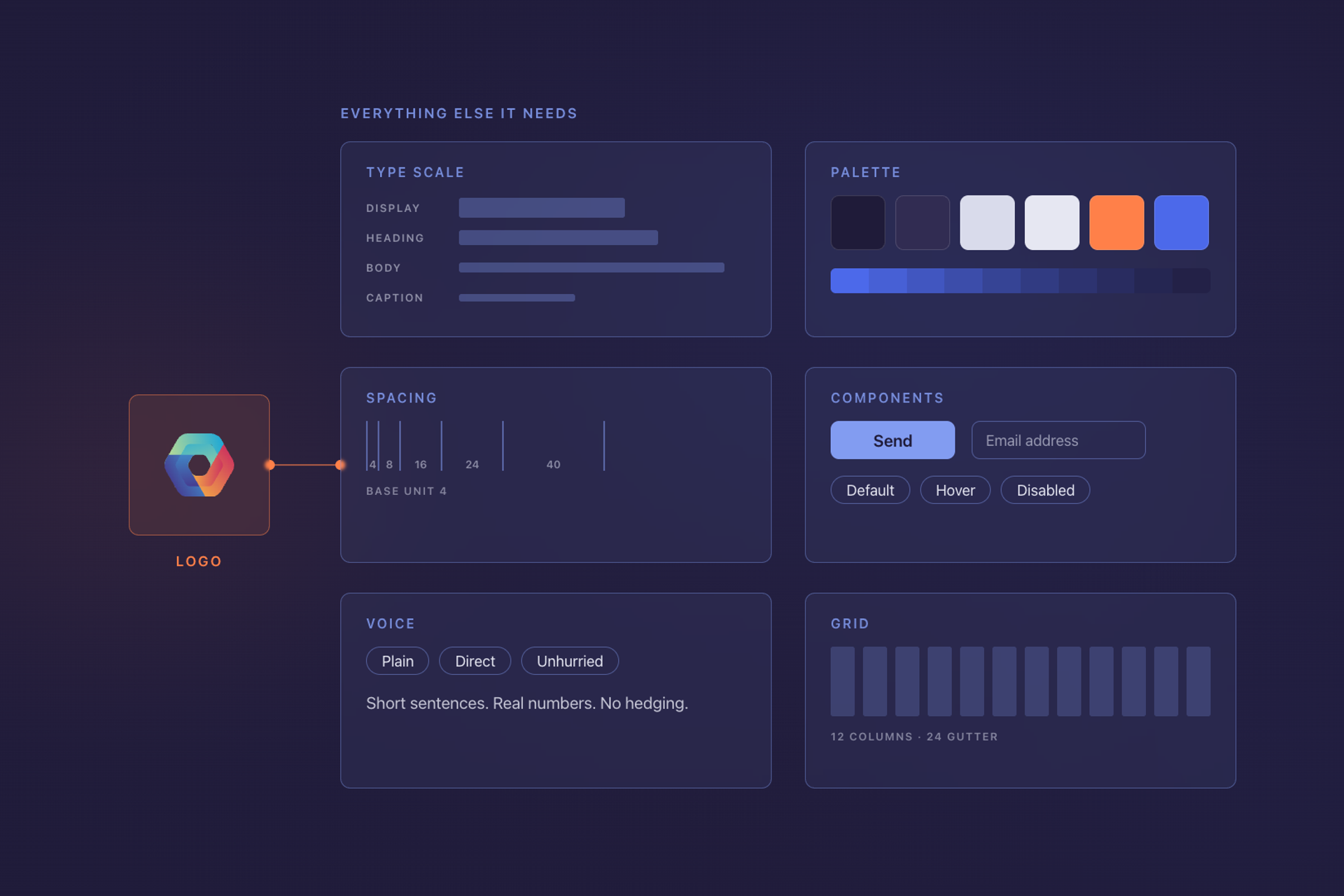
What was needed was a small set of decisions, written down: the colours and where each is used, the typefaces and their hierarchy, how photography is treated, how the mark behaves when the space is the wrong shape, and how you sound. A dozen pages is usually enough. That is what turns a mark into something that holds together everywhere your business shows up.
The cost of finding out later
It is not that redoing it is expensive, though it is. It is that the cost is spread so thinly you never see it as a cost.
It is not that redoing it is expensive, though it is. It is that the cost is spread so thinly you never see it as a cost.
It arrives as the fortnight your new brochure takes instead of the week it should, because nobody can find the right blue and two people disagree about the typeface. It arrives as the supplier who charges you to redraw a logo they were sent at the wrong size, and as the presentation rebuilt from scratch because it looked nothing like the website. And it arrives, every single time, as the argument about whether this piece of work looks right, conducted entirely on taste because there is nothing written down to check it against.
None of those lands as a bill for missing brand guidelines. They land as things taking longer than they should, which is why the diagnosis usually comes years late, at the point somebody finally counts.
What to do about it
If you are commissioning a logo, ask what else comes with it and what it costs to add. The gap between a mark alone and a mark with a modest system around it is usually smaller than people expect. It is far smaller than the gap between doing it now and doing it again in three years.
And if you already have a logo and none of the rest, you do not need to start over. Write down what you already do, pick the right version where it currently varies, and put it somewhere anyone can open. Most of the value is in the decisions being made once, not in who makes them.
That second job is one we do often, and it is usually a fortnight rather than a rebrand. Take what a business already has, settle the places it varies, and write the dozen pages that stop it varying again. It is the cheapest piece of design work most companies never think to commission.
Azeem Hadi
Got a project in mind?
Or just want to talk through an idea? We are always happy to chat, no strings attached.
Thirty minutes, direct with the founder. No pitch deck.